Saturday, 1 August 2015

1960s Bridal Beauty

Last year I bought this wedding gown from the late 1960s. Judging by the sleeves, I have dated it to 1968-1970. It was really beautiful but oh so badly stained, but I thought it was worth the gamble of being able to restore it.


The marks were a lot worse than have shown in the photo, with dark stains across the base of the bodice as well. But around the hem and train were the worst affected areas.

I would like to know what these mysterious marks are that appear on old clothing. Rust coloured, but not rust. Garments frequently look as though they have been used to wipe down a rusty fence. I can find a lot of information on the internet on how to remove these stains, but no explanation of how they get there in the first place. I guess it must be a chemical reaction between something in the garment and something in the air or environment over time.

Solution no.1 - Laundry soaker. I use Napi-San Oxy Action for whites. There is another formula for coloureds. And while I can hear vintage clothing sellers out there going "tut, tut", about treating old garments this way, what have I got to lose? Nobody would want to wear it in this state. You'll be glad to know that if I'm ever lucky enough to find a 1920s silk sequined dress I won't be soaking it. Many hard core vintage sellers say you mustn't wash vintage garments at all, and while I agree that's true for the flapper dress, lots of other garments are worth the risk of a soak and wash to make them more wearable. I don't like that musty old smell either. Most things are better for a freshening up. I have only had one or two minor tragedies so far.

So, into the bath she went.


Some of you may have read an earlier post where I also washed my daughter's wedding gown in the bath tub "Here she goes again," I hear you say. Never fear, Evie's gown went into the gentle wool washing detergent, not the soaker.

I call this dress the Juliet gown. I called it this the day I bought it, because it reminds me of the dresses worn by Olivia Hussey in Zeffirelli's 1968 version of the play. These dresses had the Empire line and puff top fitted sleeves popular both in Renaissance times and in 1968!

So, the dress came out of the bath a lot whiter than it went in. However, there were still a number of marks around the hem, particularly on the train. Next idea? 

Solution No.2 - The Great Australian Summer.
The dress hung about my office for a few months until we had some hot weather.

Fittingly hanging out with the Norton Anthology of Poetry.

In the summer, it went out onto the clothesline for a couple of weeks. The sun is a great natural bleacher, think animal bones in the desert or a surfie's hair. Back in the days before we had safe laundry soakers housewives got their nappies and sheets whiter than white by boiling them up in the copper and hanging them out in the sunshine. If you rely on your tumble drier, try sunshine for your whites.

All the marks disappeared and the dress is now perfectly white and smelling of sunshine and fresh air. Luckily, the air is clean around here.

The only other attention it needed was a careful iron and a tizzying up for the bows. These all needed to be pressed and had their frayed edges trimmed.
So, now it's beautiful.


My favourite part of this dress is the sleeves. These zip up almost to the elbow.

Hopefully, there is a petite young lady out there who is looking for a different kind of wedding dress. The size on this dress is XSSW (or extra small, small womens, as the 60s sizing went). This is roughly about a modern Australian 6 or a small 8, bust 78 cm (31 inches), and not too tall.
It may take a while to find that perfect girl, but one day she will find it.

See the dress in my Etsy store:

Juliet Wedding Dress


Tuesday, 30 June 2015

A Little Stunner

Some of my pieces are really special, and I thought I'd share this one with you.


When I found this, the shop ladies thought it was a marching girl's jacket from the 1950s. How interesting, I thought, and promptly took it to show my Vintage Fashion Consultant (aka, mother). Mum was a marching girl back in the 1950s and she said no, it wasn't. She was quite definite about that. After looking at pictures of marching costumes on the internet, I could see that she was right. She said it certainly wasn't a costume because of the quality in the making of the garment. Both the cuffs and collar of this jacket are elaborately quilted. The pockets are real pockets. The pockets and cuffs are appliqued in an ornate style. 


She also said it reminded her of the little cropped jackets she often saw in one of her favourite TV shows, Poirot. I looked at it again. Could it's unusual ornamentation be 1930s  Art Deco rather than a costume?

The tag on the jacket reads "Walter Huppert - Melbourne". I could not find anything about this brand on the internet, including in Trove, which is the wonderful website of the National Library of Australia. Amongst other things, they have thousands of old newspapers digitised and indexed. References to brand names often come up as advertisements, which is great for locating the time and often the place where the company operated. However, this time I drew a blank. No Walter Huppert.


 It was time to consult the other experts.

The Vintage Fashion Guild has a wonderful website full of resources for identifying the age, make and style of garments. They also have a forum where anyone can register as a guest and join the discussion. One of the threads is a Q & A about any garment you would like others' opinions about. I posted my query. All agreed they had not seen anything quite like this jacket. It was suggested that I look closely at how the garment is constructed for clues.

So I did. The lining is silk and is mostly hand sewn, and hand stitched to the garment. It is also pleated in the back. There is a long strip inserted in the underneath of the sleeve, helping to achieve a rounded rather than a flat sleeve shape. The pockets are real pockets, not just for looks. They are made of the same silk as the lining. The fabric appears to be a good quality wool felt.


In the end, I have to thank the guru of Australian vintage, Nicole Jenkins of Circa Vintage for giving me her decisive opinion that this is a  fine tailor made 1950s jacket, and very cute! It's also in excellent condition. Nicole obviously has superior search skills to me because she also managed to find an advertisement for Walter Huppert, tailor, in a newspaper from the late 1940s. He was in business in Howey Place, Melbourne. I walked through Howey Place a few weeks ago hoping to find an old sign saying "Walter Huppert", or at least "tailor" painted on the brickwork in an obscure corner or side alley, but unfortunately, no. Interestingly, though, there is a tailor's shop still in business that backs onto Howey Place. I wonder?...

Wednesday, 17 June 2015

Beetle Wings For Lady Macbeth


A while ago in a post about Edwardian  needlework, I mentioned beetle wing embroidery. Today, I was very interested to read this article about the painstaking restoration of Victorian actress Ellen Terry's beetle wing embroidered dress which she wore for her role as Lady Macbeth. She was famously painted in this role by John Singer Sargent.

Where Beauty Transcends Time: The Archaeology of a Dress -- Secret History -- Sott.net: http://www.sott.net/article/226601-Where-Beauty-Transcends-Time-The-Archaeology-of-a-Dress

It's comforting for me to know that there are other people out there besides myself who take on crazy time consuming repair projects out of a desire to restore an item to its original beauty. It looks like I missed my calling as a costume conservator.

Monday, 1 June 2015

Do You Have Your Hankie?

Last week I was lucky to find a stash of vintage handkerchiefs.  It seems that they all belonged to one lady and I was instantly reminded of my grandmother, Louisa Amelia Jane, though those who were on first name terms with her called her Lou. Having said that, not many people seemed to be on first name terms with her. In our family, she was Nana or Mum. To the rarely seen cousins she was Aunty Lou, but to most people, she was Mrs Silva. It interested me that Nana called all her friends by their formal titles of Mrs Spencer, Mrs Dubbledan, Mrs Sherman, etc. Sometimes I wonder whether she ever knew their Christian names. But I digress... Back to the hankies.


Nana was the kind of person who, when they received something really nice as a gift, deemed it too nice to use, and put it away in a drawer or cupboard, perhaps to take it out and look at it occasionally when in the mood. Or it was kept "for best", and probably never used. I must confess that when my daughter was small and asked me when we were using the best teapot and cups on the dresser I said "When the Queen comes for afternoon tea." Abbey spent years anticipating this event with curiosity until she eventually gave up.

The lady who owned these hankies was clearly a like minded soul. It seemed that for years family and friends had given her pretty hankies as gifts, and she clearly thought they were all far too good to wipe her nose with as most of them still bore the original sticker saying "Swiss cotton", "Made in England", etc. Unfortunately, I had to remove these to launder the hankies as most had brown age spots. Most tore when being removed.

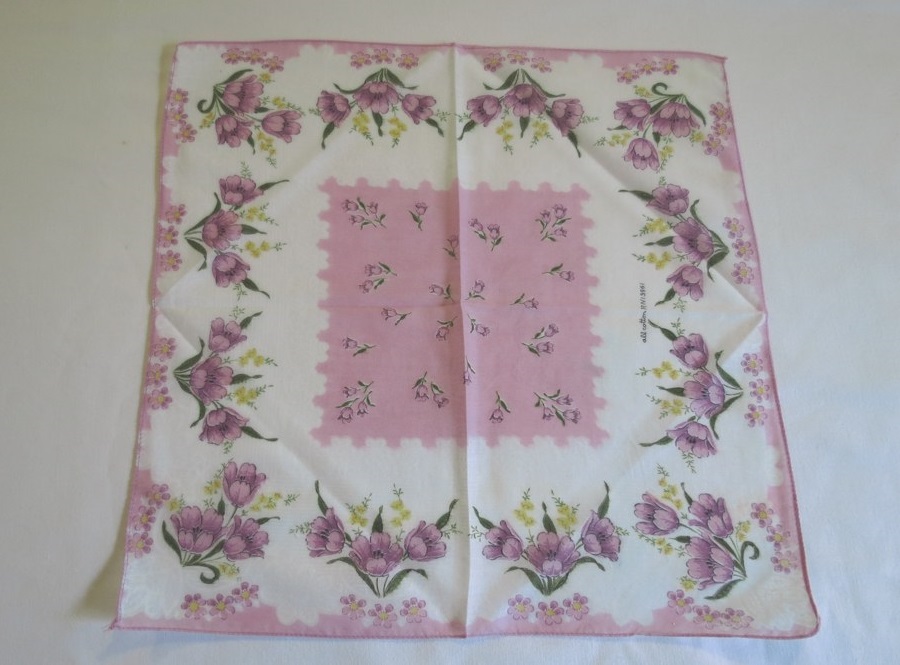
The hankie stash included lace, embroidered, floral and souvenir hankies and seemed to be from the 1950s and 1960s.  Here is my favourite:

Fine Green Lawn Hankie - 1950s

Here is a curious one. Clearly a souvenir from the Gold Coast and sporting some funky vintage bathing suits, the map has been printed upside down. I was confused about this for a while and had to check, but if you turn it upside down, the map is the right way, but all the text and other pictures are upside down. I hope they got it cheap. Perhaps it's like the misprinted stamp that collector's covet and is worth a mint, but I doubt it.

Upside down Gold Coast souvenir

Call me strange, but I actually enjoyed ironing this pile of handkerchiefs. When I was a child I remember asking my mother whether I could "help" with the ironing, and she let me iron the hankies. I guess it was hard to go wrong there. I do not remember my own children asking to help with the ironing. Just as well because we didn't have hankies. I enjoyed taking the newly clean and dry hankies, flattening them and folding them into little triangles with the prettiest corner showing.

Organdie floral hankies with the original sticker
This pair is my second favourite. The fabric is really beautiful - transparent, gauze like organdie with a restrained floral pattern.

Lace corner with embroidery and lace trim

Then there are the dainty lace hankies, with or without embroidery. Definitely for taking to church on Sunday in one's best handbag. Not for tucking up the sleeve as they may fall out and be lost. 

Pretty lace borders

However, I was delighted to find a pile of floral hankies. I had hankies like this when I was a child, they were the kind I had ironed, which must explain why I was pleased to see them again. After I grew out of babyish hankies with cartoon characters I graduated to florals. I never had a lace number, not even for Sunday School.


These are my favourites of the florals:

Poppy hankie

Crocus hankie

And I have to mention the three very delicate pink ones just because they're pretty.

Three pink pretties

 There are lots of others - embroidered sets, petit point, florals, a thistle souvenir from Scotland.

I have seen quite a few interesting projects for upcycling vintage handkerchiefs. When a customer first told me that she was intending to make doily lanterns with doilies she bought from me I felt sad that this was to be their fate, but I got over it. Doilies and vintage linens have received a new lease of life by being upcycled in creative projects. I have a Pinterest board full of upcycling ideas I have collected. 
Cushion of vintage hankies

Baby dress of vintage hankies

Butterfly quilt of vintage hankies

I have a drawer full of hankies I have collected for myself which I intend to use. Less tissues, save trees, reduce rubbish, you know. However, my problems are firstly, that I rarely seem to have a pocket in which to keep a hankie, and also that I forget to take one. A child's lesson from the past "Have you got your hankie?"


Sunday, 10 May 2015

Guardian Angels -The Ancestors

A few months ago I found this fabulous Edwardian over mantel in the garage at our local church op shop and promptly bought it for $10. I lugged it home where it underwent closer examination. Who were the women in the photos and why had a lady (I presumed) chosen to frame them and admire them in her house so long ago? Perhaps they were her relatives?


Although the top row was painted portraits the five below were lovely Edwardian photos. I wasn't keen on the blue mount board, which was in poor condition anyway, so I set about taking the photos and glass out of the frames.
Zena Dare

As I removed the photos I was delighted to find that names had been penciled on the back of each photo. Really, they looked too professionally posed to be relatives. When I removed the photo in the bottom left hand corner and read the name Billie Burke on the back, I thought "Aha, actresses!"and I googled. Billie Burke was famous as a stage and screen actress in the silent movie era, and survived the transition to talkies. Her most famous role was probably as Glinda the good witch  of the north in The Wizard of Oz in 1939. But what a gorgeous photo of her as a young woman! I googled some more. Lo and behold, all the women in the photos were famous actresses of the stage and screen in the first 20 years of the 20th century.

Here they are:

Billie Burke


Adrienne Augarde


What was I going to do with this interesting but unconventional item? I thought that with a bit of work it might look nice in my vintage shop, or rather, in the upstairs spare bedroom that is my online shop and office.

Unfortunately, most of the photographs tore when I was removing them from the frames, but I can't quite bring myself to throw them away.
Agnes Fraser
Madge Lessing


The painted portraits turned out to be romantic works by Angelo Asti, member of the Royal Academy, the subjects being various heroines from literature and mythology.


I scrubbed the timber, then rubbed it with linseed oil. I thought maybe I could put my own ancestors in the frames. I had some of my old photos printed in sepia and had some new mount board cut. Today, I finally got around to reassembling it and I am very pleased with the result.

I put my parents at the centre - one of their first dates in the mid 1950s.


So, here it is finished, with  the ancestors standing by in support. I have hung it at the top of the stairwell near the entrance to my office/shop.


I like to think they are my guardian angels watching over me and supporting my ventures, with the ghosts of the actresses still there in spirit.

Monday, 6 April 2015

Faigen Handbags - Fabulous and Mysterious

I have discovered the fabulous Faigen handbag. Producing interesting and high quality bags for decades, this vintage Sydney designer handbag company is proving to be somewhat mysterious, and I have been able to find remarkably little information about them on the internet.


Grey Double-hinged Leather Bag

Here is what little I know about them:

1. The have been producing high quality handbags in Australia for decades, possibly since 1927, but I have not been able to verify this date.


Black Suede Calf Skin Bag
2. The company was recently featured in a Jewish Fashion exhibition in Sydney.

Caramel Tortoise Shell Clutch


3. The company still exists, and after a long time not having produced any (or many) bags, they are planning a revival.

Grey clutch

4. They are highly collectible.


Four are listed for sale in my Etsy store, and I will be listing the other one soon.

Please, if you know anything about this company, comment or email me because I would love to know.


Wednesday, 18 February 2015

Vintage Revelations - Know Your Etiquette

Recently I purchased this wonderful book "The Etiquette of To-Day" by Flora Klickmann. Some of you who have been reading my posts may remember that I am a huge Flora Klickmann fan.
http://vintageknitpatterns.blogspot.com.au/2014/02/flora-klickmann-domestic-doyenne-and.html
Originally published in 1903, this is the second edition, from around 1910-1912 I would guess, judging by the fashions in the illustrations.

The beautiful design on the cover is very Art Nouveau and reminds me of William Morris' textile designs.


I am finding it entertaining and edifying reading. As a vintage buyer and seller, I am learning things about some of my vintage items that I never knew.

My favourite new fact: Do you know why ladies' evening gloves have an opening that buttons at the wrist?
Yes, I can hear you say, it's so that you can get your hand through the narrow wrist opening and into the hand of the glove. That's what I would have said three days ago, and it is correct. But it's only one of the uses for this aperture.
According to Miss Klickmann, it enabled ladies to eat at table without removing their gloves. This also explains why only evening gloves have this opening. Here is what she says:
When seated at the dinner table and immediately after the saying of grace:

"As a rule, ladies now try to avoid entirely removing their long gloves. The hand is slipped through the opening of the buttons and buttonholes, and the fingers are deftly rolled and disposed of under the bracelet at the wrist. This should be done quickly, as the service of the dinner will commence at once." (p.25)


Who knew? I had to try it. I found a pair of evening gloves in my shop and wiggled into them. Without too much difficulty I was able to complete the slip through and roll up action fairly quickly. The bulge above the wrist was not very attractive but I guess it improves with practice.

This ritual only occurred at the dinner table. At luncheon, for instance:
"Gloves are worn till one is seated at the table, and put on again as soon as one leaves the dining room." (p.38)
And apparently, the Americans invented the luncheon party, of which Miss Klickmann is a great fan, celebrating it's informality. Before luncheon parties became popular in the late 19th century, the British only ate with guests at dinner.


A whole chapter is devoted to problems at the table. I now know how to daintily eat plover's eggs and oysters, and I will duly remove the skins and seeds of grapes from my mouth, without a spitting action, and lay them on the side of my plate. I will not be ashamed to use my fingers to eat foods that are clearly most easily eaten that way, such as prawns or strawberries with the leaves on. Miss Klickmann states that to refuse to eat anything with one's fingers when that is clearly the only sensible option is an affectation.


Those of you who are familiar with my Etsy shop will know that I have  a mountain of vintage linen items, especially doilies. Doilies had many uses at the table, and indeed there was a specified size for each doily according to its purpose. If a table cloth was not being used, there were many doilies instead. The service plate doily was twelve inches, the bread and butter plate doily was eight inches and the doily for the water glass was four inches. The doily for the frappe, bullion or finger bowl was seven inches. (Frances Johnson: Collecting Linens, Lace and Needlework)

Miss Klickmann makes special mention of the finger bowl doily. After the fruit, if it is served, the servant would place a finger bowl and doily in front of each guest. The guest should then pick up both the bowl and its doily and move it to their left, to be used or not according to their pleasure.  She doesn't say why the servant couldn't have put it there in the first place.


When calling on someone at their home and taking tea, the rules were somewhat different. Ladies always kept their hats on when taking tea. A gentleman always removed his hat and gloves and carried them in his hands. The exception to this was the doctor, who left his in the hall with the servant. Presumably his hands would be otherwise occupied. The gentlemen, if present, always handed the tea around to the ladies. The tea had already arrived on the tea tray or trolley. Another light globe moment of revelation! That's why there are so many vintage tray cloths around. I had been thinking, gee, they must have liked having breakfast in bed, which is the only use I could think of for a tray. No, tea was always served on the tea tray or trolley. This also explains the tea stains!

The children only made an appearance if a guest requested to see them. They were only allowed in the room for a few minutes, and never allowed to eat in there, in case they learned to take liberties.


If anybody knows how to tell the difference between a tray cloth and a hand towel can they please let me know.

I love Flora Klickmann's restrained and dry sense of humour. While clearly approving of most of the prescribed behaviours she describes, she will drop an ironic comment or two for those who may be taking themselves too seriously. I love her description of arriving at a dinner party:

"The lady enters the drawing room first, and her husband, or masculine escort, follows her...at private gatherings, the man is expected to give place to the woman, and not to stride in like some Red Indian chief, while his goods and chattels follow meekly behind him. It is in entering a room that a woman shows either to the best or the very worst advantage. Do not look round nervously at your husband for protection and assistance; a man is peculiarly unsupportive at such a juncture. Therefore, if he manages to keep off your train (if trains are being worn), and to take care of his own hands, it is the utmost you can reasonably expect of him. In all probability, if he is at all a nervous man, he is thankful that it is his privilege on this occasion to come second, and trusting to make an unobtrusive entry under cover of your magnificence" (p.22)


And lastly, I was very interested to read that "Food is not discussed among refined people."  If the food is bad, clearly it would be very rude to mention that, or indeed to mention that you don't care for a particular dish. If the food is good, it is even more important not to mention it. 

"no one likes it to be supposed that they must eat and drink as much as they can at their friend's, because such luxuries are unknown at their own dinner table". (p.48) 

The reason for the dinner party is social and not culinary. I wonder how they would like that on Master Chef?
 
P.S. March 13th - I have just found another copy of this on ebay for anyone who may be interested, and it looks like it's in good condition.


References:

The Etiquette of To-Day, edited by Flora Klickmann; second impression; London; The Girl's Own paper & Woman's Magazine

Johnson, Frances; Collecting Antique Linens, Lace and Needlework; 1991; Radnor Pennsylvania; Wallace-Homestead