Showing posts with label vintage linen. Show all posts

Monday, 1 June 2015

Do You Have Your Hankie?

Last week I was lucky to find a stash of vintage handkerchiefs.  It seems that they all belonged to one lady and I was instantly reminded of my grandmother, Louisa Amelia Jane, though those who were on first name terms with her called her Lou. Having said that, not many people seemed to be on first name terms with her. In our family, she was Nana or Mum. To the rarely seen cousins she was Aunty Lou, but to most people, she was Mrs Silva. It interested me that Nana called all her friends by their formal titles of Mrs Spencer, Mrs Dubbledan, Mrs Sherman, etc. Sometimes I wonder whether she ever knew their Christian names. But I digress... Back to the hankies.


Nana was the kind of person who, when they received something really nice as a gift, deemed it too nice to use, and put it away in a drawer or cupboard, perhaps to take it out and look at it occasionally when in the mood. Or it was kept "for best", and probably never used. I must confess that when my daughter was small and asked me when we were using the best teapot and cups on the dresser I said "When the Queen comes for afternoon tea." Abbey spent years anticipating this event with curiosity until she eventually gave up.

The lady who owned these hankies was clearly a like minded soul. It seemed that for years family and friends had given her pretty hankies as gifts, and she clearly thought they were all far too good to wipe her nose with as most of them still bore the original sticker saying "Swiss cotton", "Made in England", etc. Unfortunately, I had to remove these to launder the hankies as most had brown age spots. Most tore when being removed.

The hankie stash included lace, embroidered, floral and souvenir hankies and seemed to be from the 1950s and 1960s.  Here is my favourite:

Fine Green Lawn Hankie - 1950s

Here is a curious one. Clearly a souvenir from the Gold Coast and sporting some funky vintage bathing suits, the map has been printed upside down. I was confused about this for a while and had to check, but if you turn it upside down, the map is the right way, but all the text and other pictures are upside down. I hope they got it cheap. Perhaps it's like the misprinted stamp that collector's covet and is worth a mint, but I doubt it.

Upside down Gold Coast souvenir

Call me strange, but I actually enjoyed ironing this pile of handkerchiefs. When I was a child I remember asking my mother whether I could "help" with the ironing, and she let me iron the hankies. I guess it was hard to go wrong there. I do not remember my own children asking to help with the ironing. Just as well because we didn't have hankies. I enjoyed taking the newly clean and dry hankies, flattening them and folding them into little triangles with the prettiest corner showing.

Organdie floral hankies with the original sticker
This pair is my second favourite. The fabric is really beautiful - transparent, gauze like organdie with a restrained floral pattern.

Lace corner with embroidery and lace trim

Then there are the dainty lace hankies, with or without embroidery. Definitely for taking to church on Sunday in one's best handbag. Not for tucking up the sleeve as they may fall out and be lost. 

Pretty lace borders

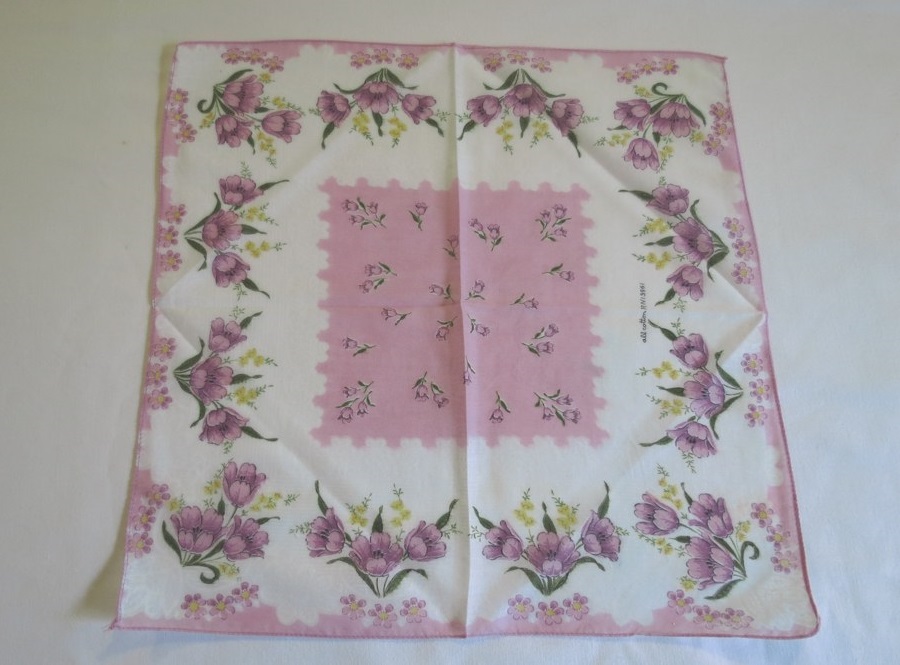
However, I was delighted to find a pile of floral hankies. I had hankies like this when I was a child, they were the kind I had ironed, which must explain why I was pleased to see them again. After I grew out of babyish hankies with cartoon characters I graduated to florals. I never had a lace number, not even for Sunday School.


These are my favourites of the florals:

Poppy hankie

Crocus hankie

And I have to mention the three very delicate pink ones just because they're pretty.

Three pink pretties

 There are lots of others - embroidered sets, petit point, florals, a thistle souvenir from Scotland.

I have seen quite a few interesting projects for upcycling vintage handkerchiefs. When a customer first told me that she was intending to make doily lanterns with doilies she bought from me I felt sad that this was to be their fate, but I got over it. Doilies and vintage linens have received a new lease of life by being upcycled in creative projects. I have a Pinterest board full of upcycling ideas I have collected. 
Cushion of vintage hankies

Baby dress of vintage hankies

Butterfly quilt of vintage hankies

I have a drawer full of hankies I have collected for myself which I intend to use. Less tissues, save trees, reduce rubbish, you know. However, my problems are firstly, that I rarely seem to have a pocket in which to keep a hankie, and also that I forget to take one. A child's lesson from the past "Have you got your hankie?"


Wednesday, 18 February 2015

Vintage Revelations - Know Your Etiquette

Recently I purchased this wonderful book "The Etiquette of To-Day" by Flora Klickmann. Some of you who have been reading my posts may remember that I am a huge Flora Klickmann fan.
http://vintageknitpatterns.blogspot.com.au/2014/02/flora-klickmann-domestic-doyenne-and.html
Originally published in 1903, this is the second edition, from around 1910-1912 I would guess, judging by the fashions in the illustrations.

The beautiful design on the cover is very Art Nouveau and reminds me of William Morris' textile designs.


I am finding it entertaining and edifying reading. As a vintage buyer and seller, I am learning things about some of my vintage items that I never knew.

My favourite new fact: Do you know why ladies' evening gloves have an opening that buttons at the wrist?
Yes, I can hear you say, it's so that you can get your hand through the narrow wrist opening and into the hand of the glove. That's what I would have said three days ago, and it is correct. But it's only one of the uses for this aperture.
According to Miss Klickmann, it enabled ladies to eat at table without removing their gloves. This also explains why only evening gloves have this opening. Here is what she says:
When seated at the dinner table and immediately after the saying of grace:

"As a rule, ladies now try to avoid entirely removing their long gloves. The hand is slipped through the opening of the buttons and buttonholes, and the fingers are deftly rolled and disposed of under the bracelet at the wrist. This should be done quickly, as the service of the dinner will commence at once." (p.25)


Who knew? I had to try it. I found a pair of evening gloves in my shop and wiggled into them. Without too much difficulty I was able to complete the slip through and roll up action fairly quickly. The bulge above the wrist was not very attractive but I guess it improves with practice.

This ritual only occurred at the dinner table. At luncheon, for instance:
"Gloves are worn till one is seated at the table, and put on again as soon as one leaves the dining room." (p.38)
And apparently, the Americans invented the luncheon party, of which Miss Klickmann is a great fan, celebrating it's informality. Before luncheon parties became popular in the late 19th century, the British only ate with guests at dinner.


A whole chapter is devoted to problems at the table. I now know how to daintily eat plover's eggs and oysters, and I will duly remove the skins and seeds of grapes from my mouth, without a spitting action, and lay them on the side of my plate. I will not be ashamed to use my fingers to eat foods that are clearly most easily eaten that way, such as prawns or strawberries with the leaves on. Miss Klickmann states that to refuse to eat anything with one's fingers when that is clearly the only sensible option is an affectation.


Those of you who are familiar with my Etsy shop will know that I have  a mountain of vintage linen items, especially doilies. Doilies had many uses at the table, and indeed there was a specified size for each doily according to its purpose. If a table cloth was not being used, there were many doilies instead. The service plate doily was twelve inches, the bread and butter plate doily was eight inches and the doily for the water glass was four inches. The doily for the frappe, bullion or finger bowl was seven inches. (Frances Johnson: Collecting Linens, Lace and Needlework)

Miss Klickmann makes special mention of the finger bowl doily. After the fruit, if it is served, the servant would place a finger bowl and doily in front of each guest. The guest should then pick up both the bowl and its doily and move it to their left, to be used or not according to their pleasure.  She doesn't say why the servant couldn't have put it there in the first place.


When calling on someone at their home and taking tea, the rules were somewhat different. Ladies always kept their hats on when taking tea. A gentleman always removed his hat and gloves and carried them in his hands. The exception to this was the doctor, who left his in the hall with the servant. Presumably his hands would be otherwise occupied. The gentlemen, if present, always handed the tea around to the ladies. The tea had already arrived on the tea tray or trolley. Another light globe moment of revelation! That's why there are so many vintage tray cloths around. I had been thinking, gee, they must have liked having breakfast in bed, which is the only use I could think of for a tray. No, tea was always served on the tea tray or trolley. This also explains the tea stains!

The children only made an appearance if a guest requested to see them. They were only allowed in the room for a few minutes, and never allowed to eat in there, in case they learned to take liberties.


If anybody knows how to tell the difference between a tray cloth and a hand towel can they please let me know.

I love Flora Klickmann's restrained and dry sense of humour. While clearly approving of most of the prescribed behaviours she describes, she will drop an ironic comment or two for those who may be taking themselves too seriously. I love her description of arriving at a dinner party:

"The lady enters the drawing room first, and her husband, or masculine escort, follows her...at private gatherings, the man is expected to give place to the woman, and not to stride in like some Red Indian chief, while his goods and chattels follow meekly behind him. It is in entering a room that a woman shows either to the best or the very worst advantage. Do not look round nervously at your husband for protection and assistance; a man is peculiarly unsupportive at such a juncture. Therefore, if he manages to keep off your train (if trains are being worn), and to take care of his own hands, it is the utmost you can reasonably expect of him. In all probability, if he is at all a nervous man, he is thankful that it is his privilege on this occasion to come second, and trusting to make an unobtrusive entry under cover of your magnificence" (p.22)


And lastly, I was very interested to read that "Food is not discussed among refined people."  If the food is bad, clearly it would be very rude to mention that, or indeed to mention that you don't care for a particular dish. If the food is good, it is even more important not to mention it. 

"no one likes it to be supposed that they must eat and drink as much as they can at their friend's, because such luxuries are unknown at their own dinner table". (p.48) 

The reason for the dinner party is social and not culinary. I wonder how they would like that on Master Chef?
 
P.S. March 13th - I have just found another copy of this on ebay for anyone who may be interested, and it looks like it's in good condition.


References:

The Etiquette of To-Day, edited by Flora Klickmann; second impression; London; The Girl's Own paper & Woman's Magazine

Johnson, Frances; Collecting Antique Linens, Lace and Needlework; 1991; Radnor Pennsylvania; Wallace-Homestead


Saturday, 15 February 2014

Flora Klickmann - Domestic Doyenne and Queen of the Needle

Amongst my burgeoning collection of vintage knitting, crochet and needlework books are three treasured volumes by Flora Klickmann. I had never heard of her before purchasing one of her books on ebay recently, but her books are wonderful for anybody interested in vintage linens and how they were made.

Wikipedia gave me the following information about her.
She was an English writer, journalist and editor, for many years editor of "The Girl's Own and Woman's Magazine".


 She also published popular novels for women and girls, such as the "Flower Patch" books. She edited many books on needlework published between 1900 and 1920.

The first book I purchased was this little gem, "The Little Girl's Sewing Book":


This delightful little book was published in 1915, and as the title suggests, it is an introduction to sewing aimed at small girls. It is full of simple instructions for gifts and dolls' clothes. Many of today's adults would be challenged by skills which even small girls were expected to have in Edwardian times.


As a bonus, it features beautiful pen and ink illustrations, although the illustrator is given no credit, probably an artist doing hackwork for the magazine.


As well as instructions and patterns there is also plenty of covert moralising going on in this book, as was the custom in those days. Klickmann included  little poems she wrote for the edification of her readers:


Here are some of the adorable dolls' clothes she gives instructions for:


And their owner


This book has been republished and there are quite a few copies for sale on ebay international, though I have yet to see another original edition.


This book got me interested in Klickmann and I started searching for her other books. As well as her novels, I have found a few other original editions of her needlework books. So far, I have acquired "The Home Art Book Of Fancy Stitchery" and "The Modern Crochet Book".


You have to love the Victorians and the Edwardians for their ability to create an interminable subtitle.

If you ever wondered what to do with all those old hankies now that you use tissues, here are some ideas:


I was awestruck by the suggestions for chemise trims. Much of this lace would have been made by gaslight or candlelight. My eyes struggle with the brightest electric light, and that's just for knitting! It's also amazing for us today to think of the time and effort that people put into making everyday items beautiful. Today, we buy it machine made and throw it away when it needs the simplest mending (not me, I have an enormous mending pile, it's a bit like a Black Hole, items disappear into it, never to be seen again - Not quite, they do eventually surface for a new lease on life, albeit months later).


The ads in these old books are particularly entertaining and charming. Here are two of my favourites from Ardern's Crochet Cotton:


And I think that what was originally meant by a "brassiere" is not what we would mean today:


 Surely, they would not do all this beautiful fine work and then hide it on their underwear?

I also have "The Modern Crochet Book", also with an impressive subtitle:


I was pleased to find a pattern for swastika lace, or "Nazi lace" as my son calls it.


I have some old lace featuring this motif, but since the Nazis perverted the symbol it's hard to know how to market it these days. However, it seems to have been a popular design in its day.


Clearly, I have the lace upside down in the photo because the swastika is rotating in the opposite direction from the pattern above.

This crochet incorporates fancy braid. I've often wondered how such pieces were made. I think you would find it very tricky to find such braid these days, even if you had eyesight good enough to attempt this.


And finally, a divine petticoat trim. I wish I could see the finished garment.


In this book is an ad for another Flora Klickmann book which I would love to have. If I ever have to train a servant it will be invaluable to me:


While writing this article, I remembered that for several months I have had another of Flora Klickmann's books in my watch list on ebay, and writing this has inspired me to spend the money and buy it. I eagerly await the arrival of  "Beautiful Crochet on Household Linen". I hope I haven't inspired you all to start bidding against me for future Flora Klickmann books!


Wednesday, 5 February 2014

One Man's Trash...

Yesterday I purchased a pile of vintage linen. And when I say a pile, I really do mean a pile. I mean a mound about a metre high. So guess what I did today? Yes, lots of laundry.

One of the items I purchased was a lucky dip, a sealed bag of "stained tablecloths". Many of the other items were also stained. Last night I put them into the bath to soak in the laundry soaker.


So today was a big wash day. Luckily the weather was perfect, so, out of the bath and into the washing machine for a gentle rinse, then onto the line.

And this is only the first batch.

Oh, and hand wash the pile that didn't need soaking and hang them to dry inside.


By this time it was nearly lunchtime and time to start ironing, doing some easy mending as I ironed. Then, onto the table to photograph each cloth. I also had quite a few vintage garments to iron, including two very tricky silk numbers. One beautiful gold silk blouse had some stubborn wrinkles. A quick internet search suggested steaming to iron silk, so I held the steaming iron an inch or so above the garment for a few seconds, then pressed. It worked beautifully. I wish I had known this years ago.


I also took advantage of the good weather to wash the baby shawl I knitted when I was expecting my first baby 30 years ago. Now my daughter is expecting her first baby in a few weeks so the shawl is going to her. It had to lie flat to dry, which was tricky, but I managed well.

The pantry supplies did a good job as weights to stop it blowing away.

A few of the cloths in the soaker still had marks, but I had a contingency plan. Stage two of linen restoration was going to be a soak in a solution of cold tea to dye the item ecru. Any items that still have stubborn marks will go to Stage Three - Dye the item black.

Well, they're charcoal grey, actually.

I am really pleased with the way the black/grey doilies turned out. Stage Two has been held over to another day.

After a few hours on the line in the sunshine, most of the items were looking good. A few had marks that had faded a lot, and I have decided not to tea soak them, although I do have a pile of doilies that will get that treatment another day. Only one cloth had to be put back on the line for a blast of 35C degree sunshine tomorrow. Out of the dozen or so cloths in the "stained" lucky dip bag,  I have put aside 3 for crafting purposes, they have bits of embroidery and lace that I hope to be able to use to make something special. The rest have come up beautifully.

The mending pile has reached daunting proportions. It has second priority behind the baby knitting at the moment. It is full of forgotten treasures that I will rediscover in a couple of months time. If you are looking for long pink vintage evening gloves, let me know, and I will put them to the top of the pile - they only need new buttons.

After all of this I was feeling a tad weary. Just to cook dinner, then spend two hours watering the garden!
And it's my day off! It's back to work tomorrow for a rest!! Saving vintage treasures from the trash is a lot of  hard work, but a labour of love.

Saturday, 16 March 2013

Sorry, Not For Sale!

I thought I'd share with you some of my best finds. These are the really special things that I decide to keep, so sorry to vintage lace lovers out there.
I recently learned that both of my adult daughters share my love of vintage lace doilies and other linen, so these are the heirloom items I will pass on to them one day. Funny that I never realised that I'd passed on my interest. It took my eldest daughter's prospective mother-in-law to fill me in on that.

Here is a very special piece which I have had for years. The person who gave it to me told me that it came from Government House in Melbourne. It would be 19th century work.
19th Century Silk Doiley
This gorgeous doiley is extremely fine work made of silk. I think it is handmade bobbin lace. It's pale beige.
It has sat on a sideboard or an occasional table at Government House and seen a succession of Kings, Queens and Princes entertained in right regal style. Definitely Governors, probably Prime Ministers and Premiers. If only these items could talk, they would tell some interesting tales... on second thoughts, they would probably be terrible gossips.


In January I visited a lot of op shops in country Victoria and New South Wales and found a few treasures. I won't call them bargains, because I paid through the nose for them. But they were so beautiful I couldn't resist.
This is a superb large doiley in Irish crochet, where the little flowers are three dimensional. It is hand done in extremely fine ecru cotton. I bought this and the collection about to be described at the Vinnies (St Vincent de Paul) shop in Benalla, in rural central Victoria. It looks as though they have all come from the one source.


I would guess that these doilies once belonged in one of the stately historic homes in this area.

Tatting

When I found this pile of handmade antique tatted doilies, (in the same Vinnies store) I had to have all of them. Many of these were stained, and quite a few were a very dark ecru, actually tan.
I can barely see the threads, so I can't imagine anyone actually sitting and making these by hand with the little tatting shuttle. If you don't know what tatting is, it's done with a tiny shuttle of cotton, which you pass in and out, like a complicated and permanent cat's cradle (that doesn't pull undone). The result is a series of tiny knots around a central thread, with loops for decoration. Many years ago, (when I had leisure time, before I had babies) I learned to tat. I couldn't be bothered keeping it up, such a lot of knots and joins, and if you make a mistake, you can't pull it undone, you have to cut it off and rejoin a new piece and start that bit all over again. And you have to try to darn in about 700 ends! I suppose it's because I've done it that I can appreciate the workmanship in these doilies.
I bought 10 medium sized and four matching small doilies. I'll keep some and divide the rest between my girls.
 
When I bought these doilies, as I said before, some of them were an unusually dark brown for linen. I recently read in an old magazine, some tips for cleaning lace, where they recommend soaking the stained article in cold tea. I think this must be what happened to these doilies. I could see that they had marks, and I think the laundress had tried to disguise them by recolouring the linen. However, I popped them in the laundry soaker overnight, and they come out a lovely pale ecru, with no sign of marks. Isn't Napi-san wonderful?
 
With this pile of Vinnies doilies, I also bought two of these lovely lace pieces. I don't know how they were made. Please comment and tell me if you think you know. These had also had the tea-soak treatment, but are now restored. They look to me to be similar to guipure lace. I am imagining the stately home they all lived in, and whether or not it still exists, or whether it has been bull-dozed to make room for a new sub-division.


                                                                                 And this sweet little bobbin lace piece.
 
Back home again, you don't have to drive hundreds of kilometres to find treasures. Last week I found this fabulous piece in the Salvos store in Hastings. I'd say it's 1920s work, or earlier. Australiana was extremely popular then, as I've mentioned in a previous post.  http://vintageknitpatterns.blogspot.com.au/2013_01_01_archive.html
 I'll bet the lady who worked this devised the pattern herself. Otherwise, it's the kind of pattern that may have been published in the Weekly Times newspaper. I was sad to find that the Weekly Times no longer has a craft and pattern page.


I just love the little wrens, and the beautiful way the wattle has been worked, with little bobbles for the flowers. This piece now lives on top of the piano that no-one plays anymore.
I'm amused by the way that op shops sell doilies. They sell by size rather than quality, so you can often get an exquisite handmade lace piece for $1.00, yet they charge $5.00 for a large machine made, mass produced piece. But I'm not complaining!
So, these are the kinds of pieces I keep. My drawer is getting quite full, so I am putting together an inheritance pile for my girls. And I guess, I may have to sell some of it.