Monday, 9 September 2013

Yesterday's Child - Nursery Viyella and Motherhood in the 1940s

I am currently expecting my first grandchild, and luckily for me my daughter loves vintage baby wear too, so I am madly knitting and her grandmother is madly smocking.


Amongst my extensive vintage knitting book collection (now expanded to fill two x four drawer filing cabinets), I have three pattern books from the 1940s by Nursery Viyella. Two of them are very sweet little books of baby knitting patterns.

The third is more than this - a knitting book, a sewing book, and an advice to new mothers book.


"From The Day They Are Born" discourses on the "Principles of Clothing", by "Our Doctor Advisor",  who "is herself the mother of three boys."

I was relieved to read that the parenting ideals espoused were relatively enlightened and "modern". In the section on The Purpose of Childhood I was interested to read "The baby whose wants are regularly satisfied, whose discomforts are always speedily relieved, gains a feeling of confidence, which becomes an attitude towards life. It is only one step at this stage from momentary fear to the development of a fear attitude towards life in general - an attitude which may persist from infancy into adult life." (p.2)
I wish my mother-in-law had read this. She had four children in the 1950s and didn't feed one of them through the night, remarking to me "Well, you need your sleep." According to her, they only cried for a few nights before they gave up. This kind of thing may have allowed her to sleep, but it keeps me awake at night worrying!

 
Here is the prescribed list of clothing required for the new baby. It allows for "One on, one dirty, one drying and one clean."
Here are the rules for baby's garments:
"Nothing can be worn which interferes with the free, vigorous movement s of the little body and limbs; nothing should be worn that can chafe, irritate, or interfere with the free circulation of air over the skin. So the essentials are - garments so cut that they can neither restrict nor constrict, made of a material which is warm, light, non-irritant and porous and will remain so no matter how often it is washed. Any material that shrinks and becomes "felted" immediately becomes non-porous and is uncomfortable, because perspiration instead of evaporation remains on the skin. The shrunken garment too, is invariably constrictive somewhere - tight in the yoke maybe or tight round the wrists or neck; and this of itself is enough to drive most infants into moods of fretfulness and fear." (p.2)
 
Before I owned these books I did not know that Viyella made knitting yarn, although I had heard of the famously light and warm woven  fabric. I doubt whether there is anything similar on the market these days.


I have baby knitting books published in the 1930s which have patterns for the accursed "constrictive" garments such as this
illustration from "What to Make For Baby", by Ella Allan, a 1931 reprint of a text published from 1917 and through the 20s. Note No.43, the binder. I guess this would be worn around the infant's arms to reduce movement. Also of note is No.47, Baby's First Stays. Although these are clearly and mercifully nothing like a woman's stays, I still find the idea alarming.

And we will still wrap a small infant in a "bunny rug" for "security", but not tightly.


This lovely book also has many sewing instructions for garments for babies, in Viyella, of course. Here is a lovely ad for Semco patterns.


And how lovely is the little boys suit for a birthday party? Let's hope we can believe the caption, which reads: "Here is Peter again, all dressed up for a birthday party. His suit is made in Viyella; no no-one minds how dirty he makes it."


Here are my other favourite illustrations:

 
Imagine all the hand washing of little woolly undies for tots (and big people!) I know that ladies did not change their woolly undies daily, I've read the care instructions in magazines, but I imagine that toddlers' undies were the frequent victims of accidents. The following helpful advice is provided: "For urine and cod liver stains, soak at once in water with 1 teaspoonful of ammonia to 1 pint of water, for 5 to 10 minutes, then wash in the ordinary way."
 
And here is Lyn, ready for bed:
 
At three, we would think Lyn would well and truly be out of a cot, but maybe not. The one-to-threes, we are told, are prone to "the pugnacity tendency", which only requires the mother to "increase our efforts and so overcome difficulties." But all this, along with natural curiosity and self-assertion, are necessary for a child's development. However, "Unfortunately, very often normal outlet is denied the small child. He is kept for hours in a pram with little outlet in action for his clamouring energies." This is what causes bad temper and difficult behaviour in a toddler.
And the toddler is also very often a victim of the "Clothes Repression" if he is chastised for dirtying or tearing his clothes, once again causing emotional and/or physical damage.
 
Dr Spock's ground breaking text "Baby and Child Care", was published in 1946. The ideas expressed in the Viyella book would seem to be influenced by his more enlightened approach to parenting, so I would hazard a guess and date this book as late 40s.
 
I will be keeping an eye out for more delightful Nursery Viyella books.
 
References:
From the Day They Are Born - Nursery Viyella - late 1940s
From Birth to 8 Years - Nursery Viyella Knitting Book for Children's Garments - 1940s
Nursery Viyella Knitting Book: Over 40 Designs From Birth to Five Years - 1940s
Spock, Benjamin; Baby and Child Care; 1946
Ella Allan; What to Make For Baby, Part 1; 1931


Wednesday, 21 August 2013

Celebrities in Crochet

One thing about being in the vintage fashion industry, it's not a problem if you're behind the times. In fact, it's necessary.

Last October I posted about my surprise at how popular crochet was, and featured Jennifer Lopez in amazing pair of crochet shorts and midriff baring top. Last week I was having my hair done and browsing trashy mags, as you do, and I noticed Paris Hilton sporty a gorgeous crochet dress/coverup. This got me thinking, what other celebrities like crochet?  I googled a whole lot of photos, which told me that crochet was really popular in 2011! Only two years too late.

This is what, or rather, who, I found:
Beyoncé loved it so much, she bought it in two colours.


Cate Blanchett does granny squares
with style - artsy and classy.
I can't imagine anyone else getting
away with this one.


Eva Longoria's dress is just exquisite. I wish I had the pattern (again!). Classy, cool and pretty.

Kourtney Kardashian's mini dress is almost as cute as her little boy.


Miranda Kerr's mini is cuter (or not) than her big boy, Orlando, depending on who you ask.


Selena Gomez and her version of the cute mini:


I wonder if any of these gals knows a crochet hook from a knitting needle.


And, finally, Paris Hilton, not in the dress I saw which inspired this article. I can't believe there's no photo of the white one, but this black one is very similar. Clearly, she has a wardrobe full of them, not to mention the famous trikini.


I bet there's an army of granny's out there trying to replicate the pattern for this onesie.
If I find it, I'll let you know.

Saturday, 10 August 2013

Callot Soeurs - Gatsby Inspiration

My newest addiction is Pinterest. Given time for a leisurely breakfast and I will unwittingly lose two hours trawling the net for new pins for my fashion decades pinboards. I justify this by telling myself that it's research for selling vintage fashion items, which it is, but it's still an indulgence.

The highlight of these fishing expeditions has been my discovery of the house of Callot Soeurs, of whom I had never heard until now. This Paris fashion house created the most exquisite gowns throughout the first three decades of the 20th Century, and into the 30s, until going out of business in 1937. Last night I even dreamed of Callot Soeurs.


Callot Soeurs was a French fashion house established by the four Callot sisters, Marie, Marthe, Regina and Josephine, in Paris in 1895. All four were taught by their mother, who was a lacemaker. For the next decade they made glorious Edwardian  fashions, but it is in the 1910s and 1920s that they made the garments that truly amaze me.
Here is an example:


This dress was made in 1908, but looks to me quite different from the prevailing fashions of the era, with their wasp waists. The waist is raised, clearly indicating the direction which fashion would be following in the 1910s. I like to think of the 1910s, at least the early years, as the Titanic era. The front panel and bodice of this gown are elaborately beaded. There is an interesting mixture of textures, with the silk, the net and beading, and the velvet yoke.
 
In the 1910s, Callot Soeurs made some extraordinary dresses. Here are a few of my favourites:


This embroidered tunic and leggings was made in 1910! It must have been a very daring if not somewhat Bohemian outfit for those days.
 
 
This stunning embroidered rose silk dress circa 1909-1910 is in New York's Metropolitan Museum of Art. It has a train and an elaborate gold lace bodice. I can't decide whether I am more impressed by it, or this next one:
 
 
Another impressive train, which I would like to see spread out. This art deco gem is from 1919, and also in the Met. The bodice is silver lace, matching the lace on the train, and the skirt is silk velvet embroidered in silver thread.
 
And I can't leave the 10s without mentioning this amazing silk tie dress,  made in 1918:


And so into the modern era. The 1910s seems to be the time where the old, Victorian/Edwardian world was phased out, and the new 20th century world ushered in. It was probably World War 1 that had such a profound effect on the world.
 
The 1920s always seem to me the first decade of the modern era. It was certainly a time of excess, as examining these elaborate dresses has made clear to me - beading, lace, embroidery, fur, feathers, metallics, velvet, all these feature prominently in the fashions of the 20s. Here are some Callot Soeurs stars of the 20s:


So Deco! Evening Dress, 1924-25
Embroidery on silk.


I love the colours in this silk dress, and the Art Deco embroidered panel is amazing.

 
Evening dress, 1926

 
This glorious silk dress is embroidered with metallic thread.

 
So Deco, this amazing tiered, beaded evening dress, embroidered with metallic thread.


Gorgeous oriental inspired piece embroidered in metallic thread.


I would like to know whether this sheer embroidered dress was worn over an under dress, or just a slip...surely not just one's knickers and cami!!


This Callot Soeurs wedding gown is from 1926.


 I was surprised to read on Wikipedia that Callot Soeurs was not popular with American buyers, who apparently considered it unfashionable. It seems funny that anything from Paris could ever have been considered unfashionable.

Callot Soeurs continued to produce glorious gowns into the 1930s, but the Depression took its toll, and the fashion house closed its doors in 1937.

Many of these gowns are amongst the collection in New York's Metropolitan Museum of Art, which has 127 Callot Soeurs gowns in its collection. You can browse them at:

http://www.metmuseum.org/collections/search-the-collections?ft=callot+soeurs&noqs=true


 Join Pinterest if you haven't already, and follow me. I have pinboards for 1900s to 1960s, plus boards for my Etsy store. But be warned, it's highly addictive!


Sunday, 21 July 2013

Handmade Country Wedding

In April my eldest daughter, Evie, was married. Her husband, Zack, is a country boy and his parents have a farm in country Victoria so they decided to have the wedding there. Zack's parents embraced the task of hosting the wedding with great gusto. They have two sons, and the eldest was married overseas, so they were thrilled to have a wedding to plan and to be involved with.

I had no idea that when country people say they're going to do it themselves, they really mean it. They hired a marquee and dance floor and caterers, but they did just about everything else from scratch.
OK, so I know that many handy people can sew dresses (we didn't) and even maybe make the cake (Zack's mum, Ros, did that) and most people are involved with decorating the venue to some extent, but did Zack and his father Kym know what they were in for when they had the bright idea of making all the furniture themselves? Kym used all the boards he had pulled up from the floor of the woolshed and combined it with found timber from the property to make rustic and truly original tables and chairs for all the guests. This took them a couple of months, and they were made and stored in the woolshed. Then, a week before the wedding, there was a huge dust storm. I don't know whether you've ever been in a woolshed, but the floor is raised so that the sheep can be penned underneath, and the boards well-spaced for ventilation. The dust blew right through the shed  and up through the floor, covering everything. Guess who got the job of cleaning the furniture? Well, handy farm skill learned, how to use an air compressor to blow off the dirt.


Zack's Uncle Chris is a carpenter and he made all the special pieces of furniture, such as the amazing bridal chairs. Separately, they are halves, together a whole. Chris made all of the outdoor furniture, including a rocking chair.


One week before the event, this was a bare paddock covered with dust from the storm. Kym had lovingly tended the patch of grass for months right through a typically dry Australian summer in a drier country region. Two tanker loads of water and lots more from the mains went into this grass. It was the only patch of grass for twenty kilometres (some of the locals said 200!) Keeping the rabbits and the kangaroos off it was a challenge.
A couple of days before the wedding, friends and neighbours  of Kym and Ros  arrived for the makeover. One day before, in a military style operation, holes were sunk, plants in pots were dropped in and mulched around with sand, temporary fencing erected, a "dunny" built and plumbed for the male guests (the ladies' were getting a Porta Loo), a kitchen built and plumbed in the marquee and all the furniture moved in. According to my partner, Geoff, he and I failed the efficacy test and we were put on manual labour.
 
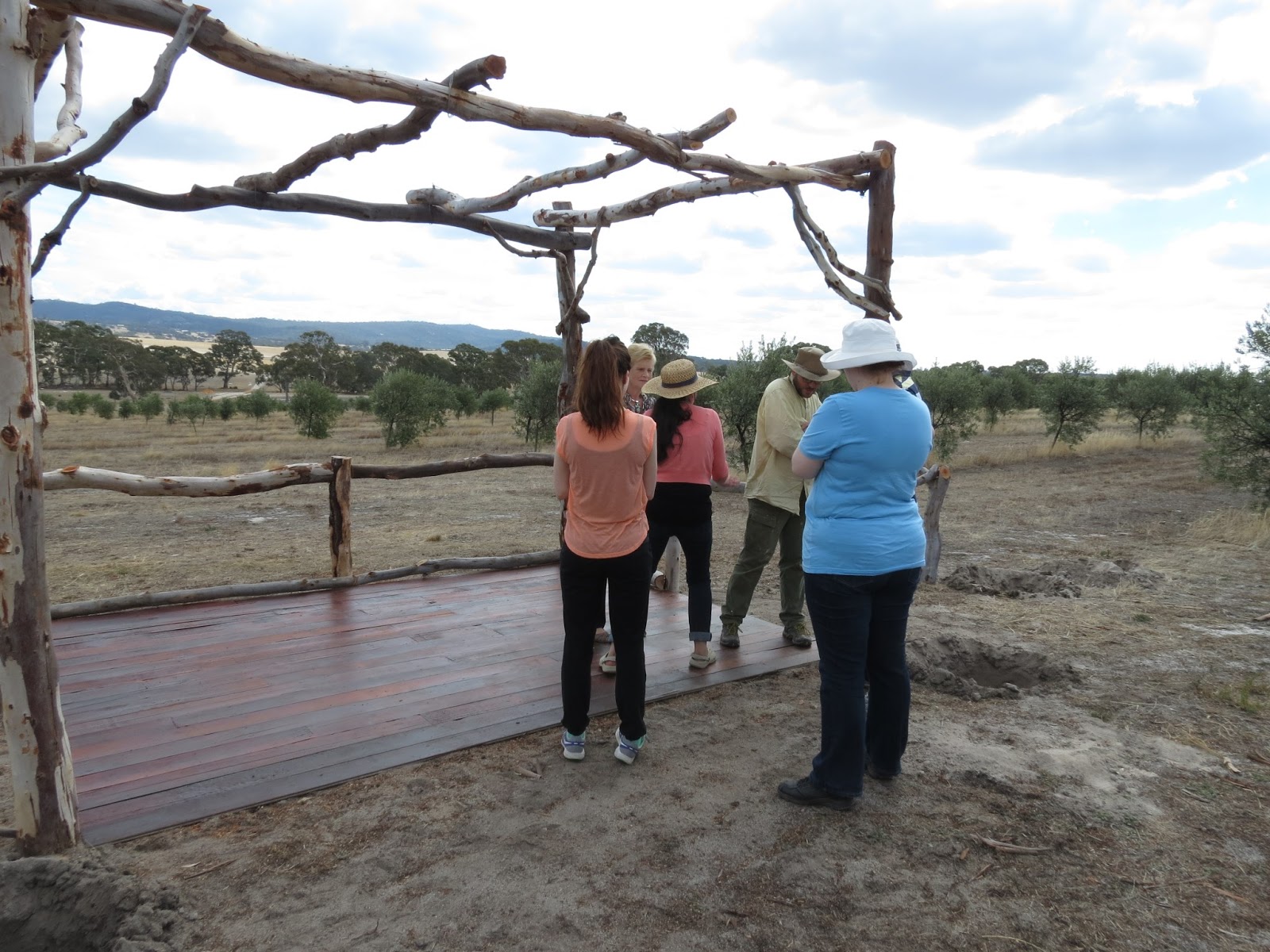
Kym and Zack had also built a pavilion for the wedding ceremony in the middle of the olive grove. Three hours before the ceremony, this was trimmed with tulle and plants were sunk around. Of course, they built all the pews for the guest seating as well.


Kym acquired a windmill. As he says, when people visit a farm in Australia, they expect to see a windmill, so they had to get one. Besides, he needed something to mount the lighting on. He also borrowed a third wheat silo from a neighbour to hide the car park from view. (As you do).
 
Inside the marquee, things were coming together on the Friday. I washed down the tables and we set them up. Evie wanted a sweet stand full of lolly jars, so of course the boys had built one. It was a hit with the adults as well as with the children. My favourite piece of indoor décor were the concrete sheep troughs filled with ice to chill the drinks. Zack and Kym manoeuvred them the ancient way, on rollers.
Evie had spent a lot of time creating beautiful invitations, and she also applied her calligraphy talents to the place settings. She used paper cake doilies for place mats and penned each persons name on them. Many guests took them home as souvenirs. Evie had also spent months hunting in vintage bazaars for old pieces of crystal and silverware, which featured on every table. She also found an eight branch candelabra for the bridal table and longingly wished for a chandelier. Much to her surprise, one appeared overhead on the wedding day. (Thanks Al).
 
One of Kym's former careers before farming was a florist, and he did all the flowers, with a little help from his mother, Pat. He built the amazing floral stands, then filled them. Of course, he did all the bridal flowers too.


 Zack's mum, Ros, had her army of friends and relations baking for weeks to provide afternoon tea for the guests while the bridal couple were off having photos taken. Afternoon tea was served from the back of Uncle Chris' 1929 Chevrolet ute.
 
My one small contribution on the creative side was the doiley lanterns. I also collected and supplied 110 vintage white table napkins. The bride and her sister made bunting. Warning! Doiley lanterns are fragile. We had intended to put LED tea lights in the lanterns but forgot to buy them. They looked beautiful anyway.
Evie wanted something more interesting than a chalkboard to display to guests what table they were seated on, and had the idea of writing on an old window. Uncle Chris drove 400 kilometres to get one.
 
Geoff and I had gone up to the country a few days early with the intention of helping to set things up. We thought this would be a 9-5 job. Kym and Zack worked from dawn to midnight the week before the wedding to get everything ready, on top of months of other work.  Ros held the fort in the background and dealt with various crises, including the florist not having received the flower order!!! We city slickers couldn't handle the pace and fell into an exhausted heap by (a late) dinner time. I went "home" to iron bridesmaid's dresses and various assorted glad rags.
 
 
The end product was truly amazing and unique. The bridal couple have beautiful photos taken on the family property and at the neighbouring winery. The weather was perfect.


What a very special wedding


Tuesday, 2 July 2013

Vintage Fashion Consultant No.1 - My Mother

See my Etsy store: Louisa Amelia Jane

Whenever I find a lovely garment or accessory and I need more information about it, I take it to Mum's and ask her about it. After all, she was a young woman going to dances and dating in the 50s, she made her own clothes, and she worked in a department store selling patterns and haberdashery. She knows what was in, what was passé, and what came later when she was a young mother.

Here is Mum, also known as Lorraine to most, as a young child in about 1940, pictured with her older sister, Joyce.
 
 She was so proud of her ringlets. She remembers wearing her hair to bed in rags. When she was in Fairfield Infectious Diseases Hospital with scarlet fever in 1944, she remembers being disgusted when the nurses plaited her hair, telling them proudly, "My mother doesn't plait my hair, she curls it." She was there for seven months, and not allowed to see her mother once. How hospitals have changed, thank goodness. Just look at the beautiful way the girls are dressed. Her parents had very little money, but my grandmother always took pride in having her girls beautifully dressed. Notice their matching embroidered dresses. I love Joyce's shoes that tie with a bow. Whenever I see photos in old knitting books of girls with ringlets in their hair, I think of this photo, and I think early 1940s.

My next photo is not one of sartorial splendour, and my mother always laughs about it. Here she is as a 14 year old, in the Goulburn River on a family holiday. She is modelling some not very gorgeous knitted bathers, on the right. They were daringly two-piece, and my grandmother made her wear her cotton singlet underneath for modesty's sake, as you can see. I imagine that these bathers not only went saggy when wet, but also embarrassingly clingy.


So, therefore we have... two-piece bathers - 1950. Knitted bathers still commonly worn - 1950.

When Mum left school she worked at several jobs, but as an older teenager she worked at Reed's Department Store, on the corner of Malvern Road and Chapel Street in Prahran, Melbourne. Later this store became Moore's, and is now Pran Central Shopping Centre, its distinctive dome a landmark in the local area. In this once grand store, Mum worked in the haberdashery department, and even did the odd modelling job. I was recently chatting to her about Madame Weigel and her sewing patterns, mentioned in the last post. She said, "Yes, they were very popular in the 40s, but by the time I started at Reed's in the mid 50s they were being phased out." Thanks again, Mum - Weigel's patterns - 1940s - early 50s.
Here is Mum at a dance with my father in about 1955 or 1956. Dad worked at Reed's too, also in haberdashery I think. Clearly, it's where they met.

 
Mum and Joyce made all their outfits themselves. Joyce was a superior seamstress and made quite complicated ensembles, and lingerie. Either Mum or Joyce would have made this dancing frock. You can see it has a halter neck, a ruched bodice and a full chiffon skirt. Mum has teemed it with a light throw and silver dancing shoes (and an enormous corsage, thanks Dad).  Mum loved to dance, but sadly, Dad hated it, so she gave it up after they married.

I love this photo of Mum sitting on a fence, on a date with Dad, (the photographer).

 
She made her floral print skirt, and probably the high necked blouse underneath. A cardigan was a necessity, of course. I recently showed Mum some garments which I thought may have been either late 50s or early 60s. She resolved the dilemma by pronouncing the dress "60s, because the zip's in the back. All zips, in dresses, skirts or pants, were in the side in the 50s," and added, "and only racy women wore trousers." She never did. Also, a  cardigan I thought was 60s, could easily be from the 50s, she informed me.
 
Here is Mum as a bride with her father in 1957.
 
 
 Her dress was a beautiful damask finished satin. The long sleeves came to a point over the top of the hand. She told me that it was the fashion in the 50s to be married in a full, mid-calf length gown, but she opted for the traditional length. It was also popular for the bridesmaids  to wear the shorter length, and often to wear matching but different coloured dresses, e.g. pink, blue and lemon, or pale green, lemon and apricot.
 
A friend recently gave me a lovely little straw basket embroidered with raffia flowers. Mum pronounced it "Definitely 50s. I used to sell the kits to do the embroidery at Reed's. They were all the rage. The basket is seagrass, but the embroidery is real raffia."
 
About some jewellery I'd found, she pronounced, "No, we didn't wear anything like that." Strike 50s, investigate 40s and early 60s.?????
 
Mum, I've always wondered what I would ever do without you. This consultancy is just adding another dimension to my need.