Sunday, 21 July 2013

Handmade Country Wedding

In April my eldest daughter, Evie, was married. Her husband, Zack, is a country boy and his parents have a farm in country Victoria so they decided to have the wedding there. Zack's parents embraced the task of hosting the wedding with great gusto. They have two sons, and the eldest was married overseas, so they were thrilled to have a wedding to plan and to be involved with.

I had no idea that when country people say they're going to do it themselves, they really mean it. They hired a marquee and dance floor and caterers, but they did just about everything else from scratch.
OK, so I know that many handy people can sew dresses (we didn't) and even maybe make the cake (Zack's mum, Ros, did that) and most people are involved with decorating the venue to some extent, but did Zack and his father Kym know what they were in for when they had the bright idea of making all the furniture themselves? Kym used all the boards he had pulled up from the floor of the woolshed and combined it with found timber from the property to make rustic and truly original tables and chairs for all the guests. This took them a couple of months, and they were made and stored in the woolshed. Then, a week before the wedding, there was a huge dust storm. I don't know whether you've ever been in a woolshed, but the floor is raised so that the sheep can be penned underneath, and the boards well-spaced for ventilation. The dust blew right through the shed  and up through the floor, covering everything. Guess who got the job of cleaning the furniture? Well, handy farm skill learned, how to use an air compressor to blow off the dirt.


Zack's Uncle Chris is a carpenter and he made all the special pieces of furniture, such as the amazing bridal chairs. Separately, they are halves, together a whole. Chris made all of the outdoor furniture, including a rocking chair.


One week before the event, this was a bare paddock covered with dust from the storm. Kym had lovingly tended the patch of grass for months right through a typically dry Australian summer in a drier country region. Two tanker loads of water and lots more from the mains went into this grass. It was the only patch of grass for twenty kilometres (some of the locals said 200!) Keeping the rabbits and the kangaroos off it was a challenge.
A couple of days before the wedding, friends and neighbours  of Kym and Ros  arrived for the makeover. One day before, in a military style operation, holes were sunk, plants in pots were dropped in and mulched around with sand, temporary fencing erected, a "dunny" built and plumbed for the male guests (the ladies' were getting a Porta Loo), a kitchen built and plumbed in the marquee and all the furniture moved in. According to my partner, Geoff, he and I failed the efficacy test and we were put on manual labour.
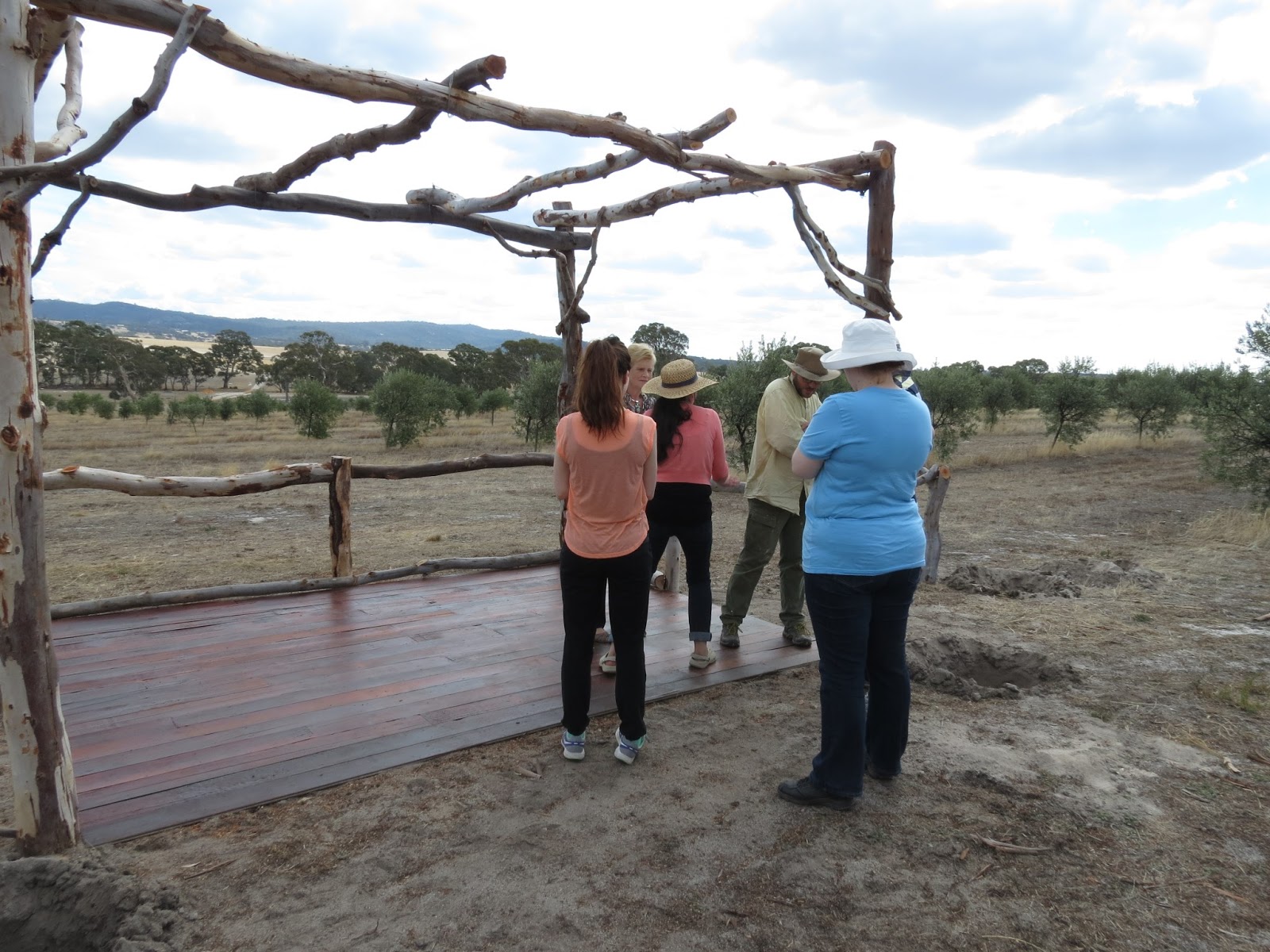
 
Kym and Zack had also built a pavilion for the wedding ceremony in the middle of the olive grove. Three hours before the ceremony, this was trimmed with tulle and plants were sunk around. Of course, they built all the pews for the guest seating as well.


Kym acquired a windmill. As he says, when people visit a farm in Australia, they expect to see a windmill, so they had to get one. Besides, he needed something to mount the lighting on. He also borrowed a third wheat silo from a neighbour to hide the car park from view. (As you do).
 
Inside the marquee, things were coming together on the Friday. I washed down the tables and we set them up. Evie wanted a sweet stand full of lolly jars, so of course the boys had built one. It was a hit with the adults as well as with the children. My favourite piece of indoor décor were the concrete sheep troughs filled with ice to chill the drinks. Zack and Kym manoeuvred them the ancient way, on rollers.
Evie had spent a lot of time creating beautiful invitations, and she also applied her calligraphy talents to the place settings. She used paper cake doilies for place mats and penned each persons name on them. Many guests took them home as souvenirs. Evie had also spent months hunting in vintage bazaars for old pieces of crystal and silverware, which featured on every table. She also found an eight branch candelabra for the bridal table and longingly wished for a chandelier. Much to her surprise, one appeared overhead on the wedding day. (Thanks Al).
 
One of Kym's former careers before farming was a florist, and he did all the flowers, with a little help from his mother, Pat. He built the amazing floral stands, then filled them. Of course, he did all the bridal flowers too.


 Zack's mum, Ros, had her army of friends and relations baking for weeks to provide afternoon tea for the guests while the bridal couple were off having photos taken. Afternoon tea was served from the back of Uncle Chris' 1929 Chevrolet ute.
 
My one small contribution on the creative side was the doiley lanterns. I also collected and supplied 110 vintage white table napkins. The bride and her sister made bunting. Warning! Doiley lanterns are fragile. We had intended to put LED tea lights in the lanterns but forgot to buy them. They looked beautiful anyway.
Evie wanted something more interesting than a chalkboard to display to guests what table they were seated on, and had the idea of writing on an old window. Uncle Chris drove 400 kilometres to get one.
 
Geoff and I had gone up to the country a few days early with the intention of helping to set things up. We thought this would be a 9-5 job. Kym and Zack worked from dawn to midnight the week before the wedding to get everything ready, on top of months of other work.  Ros held the fort in the background and dealt with various crises, including the florist not having received the flower order!!! We city slickers couldn't handle the pace and fell into an exhausted heap by (a late) dinner time. I went "home" to iron bridesmaid's dresses and various assorted glad rags.
 
 
The end product was truly amazing and unique. The bridal couple have beautiful photos taken on the family property and at the neighbouring winery. The weather was perfect.


What a very special wedding


Tuesday, 2 July 2013

Vintage Fashion Consultant No.1 - My Mother

See my Etsy store: Louisa Amelia Jane

Whenever I find a lovely garment or accessory and I need more information about it, I take it to Mum's and ask her about it. After all, she was a young woman going to dances and dating in the 50s, she made her own clothes, and she worked in a department store selling patterns and haberdashery. She knows what was in, what was passé, and what came later when she was a young mother.

Here is Mum, also known as Lorraine to most, as a young child in about 1940, pictured with her older sister, Joyce.
 
 She was so proud of her ringlets. She remembers wearing her hair to bed in rags. When she was in Fairfield Infectious Diseases Hospital with scarlet fever in 1944, she remembers being disgusted when the nurses plaited her hair, telling them proudly, "My mother doesn't plait my hair, she curls it." She was there for seven months, and not allowed to see her mother once. How hospitals have changed, thank goodness. Just look at the beautiful way the girls are dressed. Her parents had very little money, but my grandmother always took pride in having her girls beautifully dressed. Notice their matching embroidered dresses. I love Joyce's shoes that tie with a bow. Whenever I see photos in old knitting books of girls with ringlets in their hair, I think of this photo, and I think early 1940s.

My next photo is not one of sartorial splendour, and my mother always laughs about it. Here she is as a 14 year old, in the Goulburn River on a family holiday. She is modelling some not very gorgeous knitted bathers, on the right. They were daringly two-piece, and my grandmother made her wear her cotton singlet underneath for modesty's sake, as you can see. I imagine that these bathers not only went saggy when wet, but also embarrassingly clingy.


So, therefore we have... two-piece bathers - 1950. Knitted bathers still commonly worn - 1950.

When Mum left school she worked at several jobs, but as an older teenager she worked at Reed's Department Store, on the corner of Malvern Road and Chapel Street in Prahran, Melbourne. Later this store became Moore's, and is now Pran Central Shopping Centre, its distinctive dome a landmark in the local area. In this once grand store, Mum worked in the haberdashery department, and even did the odd modelling job. I was recently chatting to her about Madame Weigel and her sewing patterns, mentioned in the last post. She said, "Yes, they were very popular in the 40s, but by the time I started at Reed's in the mid 50s they were being phased out." Thanks again, Mum - Weigel's patterns - 1940s - early 50s.
Here is Mum at a dance with my father in about 1955 or 1956. Dad worked at Reed's too, also in haberdashery I think. Clearly, it's where they met.

 
Mum and Joyce made all their outfits themselves. Joyce was a superior seamstress and made quite complicated ensembles, and lingerie. Either Mum or Joyce would have made this dancing frock. You can see it has a halter neck, a ruched bodice and a full chiffon skirt. Mum has teemed it with a light throw and silver dancing shoes (and an enormous corsage, thanks Dad).  Mum loved to dance, but sadly, Dad hated it, so she gave it up after they married.

I love this photo of Mum sitting on a fence, on a date with Dad, (the photographer).

 
She made her floral print skirt, and probably the high necked blouse underneath. A cardigan was a necessity, of course. I recently showed Mum some garments which I thought may have been either late 50s or early 60s. She resolved the dilemma by pronouncing the dress "60s, because the zip's in the back. All zips, in dresses, skirts or pants, were in the side in the 50s," and added, "and only racy women wore trousers." She never did. Also, a  cardigan I thought was 60s, could easily be from the 50s, she informed me.
 
Here is Mum as a bride with her father in 1957.
 
 
 Her dress was a beautiful damask finished satin. The long sleeves came to a point over the top of the hand. She told me that it was the fashion in the 50s to be married in a full, mid-calf length gown, but she opted for the traditional length. It was also popular for the bridesmaids  to wear the shorter length, and often to wear matching but different coloured dresses, e.g. pink, blue and lemon, or pale green, lemon and apricot.
 
A friend recently gave me a lovely little straw basket embroidered with raffia flowers. Mum pronounced it "Definitely 50s. I used to sell the kits to do the embroidery at Reed's. They were all the rage. The basket is seagrass, but the embroidery is real raffia."
 
About some jewellery I'd found, she pronounced, "No, we didn't wear anything like that." Strike 50s, investigate 40s and early 60s.?????
 
Mum, I've always wondered what I would ever do without you. This consultancy is just adding another dimension to my need.

Monday, 17 June 2013

Thank Heaven for Hoarders


 My Etsy Shop: Louisa Amelia Jane

I couldn't resist this week when I saw an ad on the internet for a garage sale. The sale was headed "Granny Hoarder Gives it Up". Even better, the description promised  that after more than 70 years of hoarding, the seller had loads of bags of wool and old patterns, linen , and retro clothing. Although it was an almost 2 hour drive for me to get there, I had to go.

It was a tumble down old house  - messy, cluttered and dirty. The lady's grand-daughter was running the sale as the old lady was going into care. The driveway was lined with piles of old kitchen ware, the garage was full of tools (and tool collectors!) and when I asked the price for a box of mildly interesting patterns, the lady told me that there was a filing cabinet full of patterns inside if I wanted to come in and go through them, and kindly supplied me with a box. Did I ever!

A Patons book of plus size patterns from the 40s
This is the more glamorous model - The others
 are older "matrons".


In a ramshackle old hallway, I spent a freezing 45 minutes going through eight drawers of clutter - mostly old knitting and crochet patterns. There were quite a lot of patterns from the 40s, 50s and 60s, and I sorted out a pile of nearly 100 of the oldest ones.


I was thrilled to find these two old books from the 40s by Eve Lyn,  really Evelyn Bellamy, who published knitting books from her homes in Brighton and Elwood during the 40s. In my entire collection of more than 2000 knitting and crochet books, I only had 3 Eve Lyn books. Now I have 5, plus a duplicate of one to sell!

Her patterns are lovely and I would like to know more about her.


The lady had quite a few fabulous crochet books. My favourites are these glorious Villawool patterns from the 60s.


Surely the 60s was the most wonderful era for crochet (and hairpieces!).

And could the woman in the gorgeous white jumper on the right be Victoria Beckham's mother?


 To this stash of knitting and crochet books I added about 20 old sewing patterns, including some very old ones from the 40s and 50s. Some of these were in plain envelopes addressed to the lady. She had sent into the Sun News Pictorial, as it was in those days, for the advertised patterns.


 The silverfish had had a feast of the packets, and these had clearly been stored in the garage. Some looked like they had been dropped on the ground and trodden on (in muddy boots). But the patterns are wonderful - baby wear, doll's clothes and small girls' clothes. I have discovered that apparently tissue paper is not tasty to silverfish, so the patterns within the tatty packets are undamaged (though a few are squashed).

These dolls on the left are very stylish in their vintage 50s wardrobe.

And how adorable are these toddlers' sun bonnets?


 I have never heard of Pauline's patterns. There were two copies of this one. I am glad to read that she was reliable.

Madame Weigel's patterns were very popular in the 40s, but my mother tells me that when she worked in the haberdashery section of a Melbourne department store in the 50s, Weigel patterns were on the way out. Madame Weigel also published knitting patterns, famous for her tea cosies, and the charming "Madame Weigel's Journal of Fashion" throughout the 40s, operating out of a premises in Lennox St, Richmond.

Paragon knitting books are famous, but I did not know they also produced sewing patterns, such as for this delightful frock.

I asked about linen, and was directed to a large bag on the floor of the laundry. Sadly, most of this was dirty and   stained beyond redemption, but I did sort out a small pile I was hopeful of reviving. The lady said there was more linen  and more patterns somewhere, but she had no idea where, but I could leave my phone number for when she found them. I didn't dare to ask about the clothes, I'm way too timid and embarrassed when it comes to invading the homes of complete strangers.  I was happy with my haul, and I think we were both happy with the price.

Most of the linen has come up nicely in the Napi-san, though if anybody knows how to remove those dark rust coloured marks I'd love to hear from them.

The grand-daughter shook her head and tut-tutted to me, saying of her grandmother "She was SUCH a hoarder." I'm so glad she was. De-cluttering is fine to an extent, but re-using and recycling implies a certain amount of storing things in case they might come in handy. And a love of all things vintage relies on and loves hoarders.

Sunday, 19 May 2013

eBay Tragic for Ella Allan - Melbourne Knitting Pattern Pioneer

This week I had a most disappointing experience on eBay. This very old knitting book of baby patterns first published in the 1920s or earlier came up for auction on eBay.


 Yes, you know what's coming, don't you. There had been 5 bids on the item with 2 days to go, and it was sitting on $6.50. I set the alarm on my phone to put in a bid at the last minute, as there were obviously at least two other people interested in the item. I always try to be disciplined on eBay, and I set my reserve price beforehand, with the intention of not exceeding it. I set the reserve for this item at $18.11.
With one minute to go, I put in my bid. The item immediately went to $20.00. I increased my bid and for about 5 seconds I was winning the bid at $25.00. Outbid again,  I threw caution to the wind and upped my reserve to $34.00 and was immediately outbid again at $38.00, at which stage I thought hang it, and retired with 5 seconds to go. Boy, was I sad. I even missed the meeting I was supposed to be at. (That part made me happy!) That woman! I may have called her some impolite names. (I assume it was a "her") Who would have believed that there were at least two other people besides myself who would bid ludicrous sums of money to get this book?

This book is by Ella Allan. Here she is, from the fly leaf of the book.


This looks to me like a much older photo than 1930, the date given for the book by the vendor. I suspect that 1930 may have been a republication date for a popular book that had been around for quite a few years. Here are some of the illustrations, with baby garments modelled on china dolls.


This looks to me like the layout used in the 1920s and World War 1 era. Books from the 30s looked much more modern.
It also reminds me of a book I have. I do not know what this book is because the cover is missing, along with the first couple of pages. But check it out. No china dolls, but of a similar era, I think.


Well, at least the patterns are similar, but the layout more modern. I suspect once again, a reprint to update some classic patterns. Here are some of my favourite patterns from this book:

Baby's first gaiter.


Baby's Mocassin


Baby's Second Set of Stays


Cotton Hat


Crochet Bib

And wasn't I delighted to find this ad in the book:


Is my mystery book an Ella Allan book after all? I would have thought that the books most likely to carry ads for her books would be her own books.
The Australian Dictionary of Biography does not mention Ella Allan. (Nor does Wikipedia, by the way, just being thorough).
However, the State Library of Victoria, bless it's little heart, holds 22 items by Ella Allan, many of which have been digitised and are available online. Trove, at the National Library of Australia, lists several other of her books at other Australian libraries, though unfortunately not yet available online. Amongst the many Ella Allan books, dating from 1917 to the early 30s, I found the auctioned book. The State Library does indeed give its publication date as 193-.

My mystery book appears to be "What to Make For Baby", part 1. (the auctioned book was part 4.) I can't find the same edition in the library, the ads are different in the library's book, and I suspect mine is not quite so old.

But best of all, this is the missing cover:


We don't get naked cherubs adorning farm machinery these days.

Her books of patterns for toddlers are even more adorable than the baby books. "Dainty Adornments for Tiny Tots", which I viewed online,  includes the following patterns:

 Silk Filet Crochet Jumper
Child's Hat
Toddler's Dress


So, I haven't got the book that was on eBay, but now I know I have another book of Ella Allan's, albeit one with a missing cover and 2 pages. But, now that I have shared this with you, I hope I don't end up bidding against you on eBay another day!


P.S. One week later...
Yesterday I bought Ella Allan's What To Make For Baby, Part 2, on eBay. I got it by bidding in the last 7 seconds of the auction, and not before. And I had to pay a lot, almost $36.00!  I'm sorry if you are the person I outbid at the last minute, but then...you did it to me last week. So now we have one each. But I know there's a third person out there...

Update - June 2017.
Ella Grace Jane Allan lived in Melbourne from at least 1903, when she appears on the Australian Electoral Roll. She died in 1938, and this is when her books ceased to be reprinted. I now know that the first book  mentioned, with the designs modeled on dolls, is a 1930 something reprint "In New Form" of the book first published in the 1920s, or shortly before. The second book, my mystery book without a cover, is actually an older version from the 1920s. The 1930s books are dated, the earlier books are not.


Saturday, 27 April 2013

The Knitting Stalker

Recently I purchased this old, out-of-print book on traditional folk knitting in the British Isles.

 
Gladys Thompson turns out to be a most entertaining woman. Apparently an elderly lady when this book was first published in 1969, she is unwittingly a character in her own book. The redoubtable Gladys tours to "remote" rural and coastal parts of Britain, studying the traditional folk knitting patterns.
Interspersed between the patterns are little, whimsical observations of the fisher folk and their villages. And Gladys is really doing research the old fashioned way, going straight to the source and pursuing a lead. She hangs about the docks of these villages, spying on the fishermen and hoping to be able to observe the patterns in their guernseys, which she dutifully copies onto paper. But she has to be quick, for example in Scarborough:
 "Down by the harbour and in the fish market, or leaning against the railings, many fishermen can sometimes be seen, sometimes showing the whole Guernsey, or only a V of pattern with a buttoned up coat; or a figure in sea-boots and a brown sail-cloth smock, just showing the knitted collar and welt. This is the most exasperating of all, as you are certain that a masterpiece of guernsey knitting is hidden under the brown canvas, and unless the man can be stopped and persuaded to show the pattern, he will disappear like a flash up one of the narrow passages." (p.47)


You'll be relieved to know that she does have some names and addresses of famous knitters and visits many women in their homes, where they are always happy to share patterns - which are never written down but always committed to memory, passed from mothers to daughters. They even loan actual Guernseys and family photographs to the author.
In Flamborough the author narrates the following experience: "One day I found myself in Queen Street in the old town, and I called at a whitewashed stone cottage with walls at least a foot thick. An old lady opened the door, and when she heard I wanted guernsey patterns she asked me into the kitchen. A tortoiseshell cat sat by the fire, and an old man lay asleep on his side on a horsehair sofa. She asked me to sit down and went to fetch some guernseys from  up the yard. She showed me one or two, and then pointing to the sofa said, "Tak a leeak at yon gansey he's wearing; yer can tun him over and see t'pattern!" Thank goodness our talking woke him, and I had a look without having to "tun him over". (p.23)

Gladys' research then takes her to Scotland, where she wishes to visit Holy Island to speak with some knitters. Imagine her surprise to find that a car drives to the island at low tide. When she complains to the 16 year old driver that the water is coming through the "floorboards", she is told to put her feet up on the seats.
 
The book is full of these wonderful old patterns, and their significance is recorded where it is known. This Scottish pattern deserves special mention:
 
It was particularly difficult to record. "The last one (figure 130) took me  a long time to absorb, and I chased the man up and down the harbour side. I was only able to remember 4 different panels when he darted into The Fisherman's Inn, and I was not brave enough to follow!" (p.103)
 
Gladys also recalls visiting a cottage in Fife where she chatted to a cottager for a while and shared patterns, before the woman asked whether Gladys would like to meet "Granny in the attic", who had also been a great knitter in her day.
"Granny was standing by a window at the far end , repairing a net. Yards and yards of net - she'd a netting shuttle in her right hand, and a small pair of scissors in her left. She worked at a tremendous pace - her hands flashing in and out, snipping and netting and talking at the same time, she spoke so fast I could hardly understand her. She kept all the family nets repaired and at busy times worked in the attic the entire day - I was really sorry to say good-bye, but it was nearly their dinner time." (p.95)
 
 
Gladys also journeys to the Aran Isles to study their knitting. While admiring their beautiful creations, she is a little critical: "The highly skilled knitters turn out lovely work, but sometimes, with a true Irish touch of "nothing really matters", their knitting shows mistakes, always found in the simple patterns, and a careless nonchalance in their crossing of their cables!" (p.121) It is also her opinion that often Aran sweaters can be "over bobbled".
 
What a wonderful idea Gladys Thompson had, to record the craft work of these disappearing cultures, and thank goodness she did it when she did, because I'm guessing there's precious little left of it now.
 
Keep a look out in second hand bookshops for this little gem. Experienced knitters may be interested in adapting some of the patterns, but many more of us are interested in the history and the stories.
 
Reference: Gladys Thompson; Patterns for Guernseys, Jerseys and Arans: Fishermen's Sweaters from
                   the British Isles; 1971; New York; Dover Publications; 2nd revised edition.

Friday, 12 April 2013

Yarn updates thanks to the Glen Waverley Bazaar


Finally, I have got around to updating the most popular segment of this blog, the Yarns page. I went to the Glen Waverley vintage bazaar in suburban Melbourne with my daughter today, and amongst other treasures, I bought a pile of old Australian knitting books. Two of these were a kind of book I have never seen before, and believe me, I've seen a LOT of knitting books. (I have at least two thousand.) These books appeared to be an annual catalogue of Patons knitting books and the designs they contain, a boon for a collector like me. Also, one of them contained descriptions of all the wools produced by Patons at that time, which I estimate to be in the early to mid 1950s. I wondered why I had never seen books like this before, and I guess that although there is general knitting information, and a pattern or two, such books were not often kept for long by knitters, and mostly ended up in the rubbish bin.

The other great source for trying to find information about vintage yarns is Trove. Trove is the digitised pictorial collection of the National Library of Australia and several other State Library collections. Most of the information about knitting yarns comes from advertisements from old newspapers, such as the following:
http://trove.nla.gov.au/ndp/del/article/58969601

I have just discovered that all the patterns published in the newspapers are also indexed, so there's a another few hundred hours of my life gone.

So I will continue to update the Australian yarns as I find the information and the time, but I rely on overseas readers to share their knowledge of what current yarns could do as equivalents to vintage yarns. Let's hear from readers in the US, UK, Canada and New Zealand, and the rest of the world too, please.